The Story of the Aguila Wrens
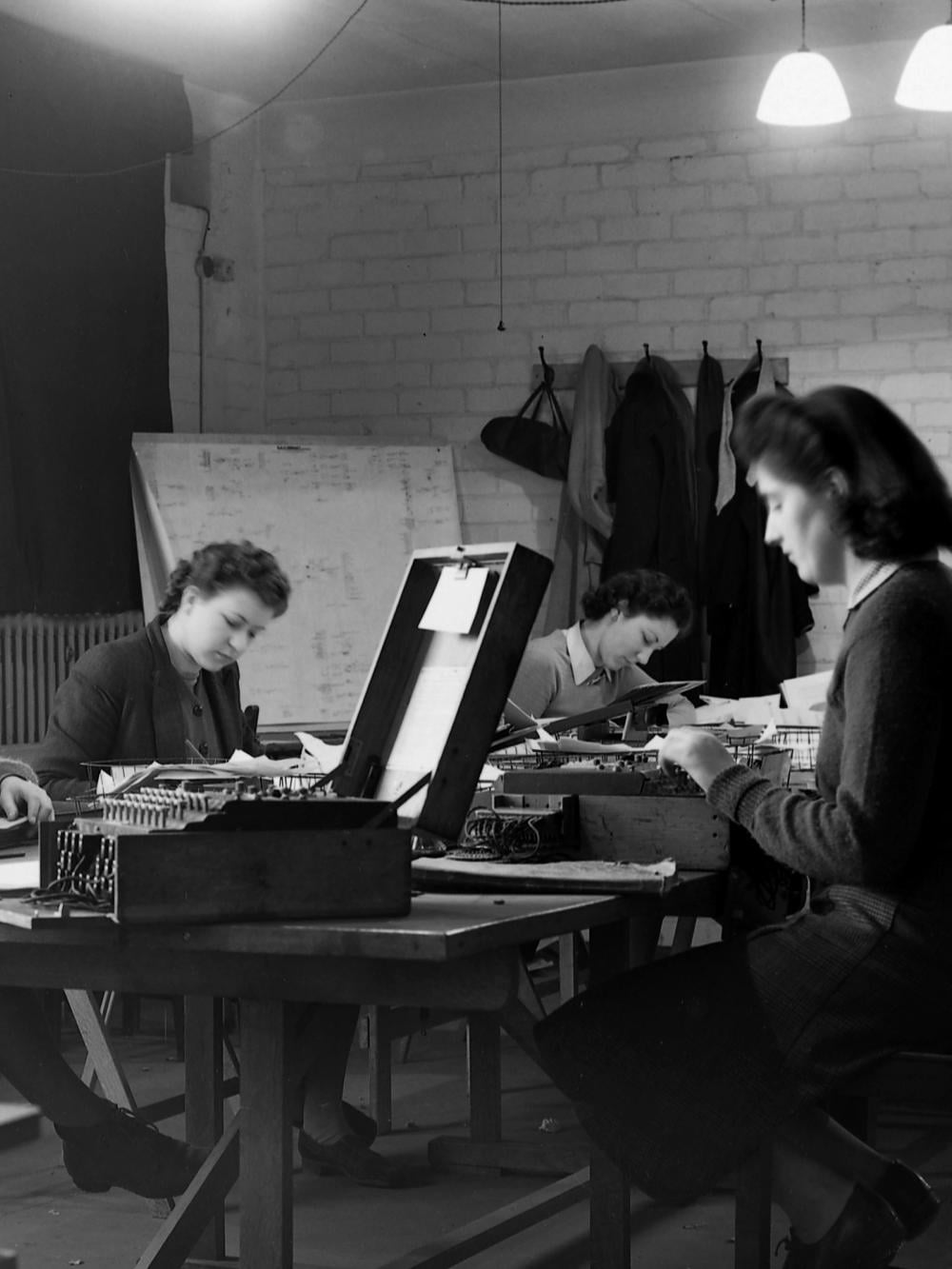
To this day, not much is known about Bletchley’s ‘secret source’ - the Y service. It was a network of British signals intelligence collection sites operated by a range of agencies including the Army, Royal Navy and RAF among others. Many of the Y Service personnel were drawn from the Women's Royal Naval Service (WRNS or Wrens), tasked with intercepting signals and identifying where they were coming from.
When intelligence was gathered at the Y stations by the Wrens, anything encoded was sent straight to Bletchley Park, and everything else was analysed locally. The Wrens were essential to breaking the Enigma, among many other crucial discoveries.
The Y station in Scarborough, established in 1914 and run by the Royal Navy, intercepted German Naval and Naval Air communications, and controlled a direction-finding network. During May 1941, the station at Scarborough played a key role in the location and subsequent destruction of the German battleship Bismarck.
In August 1941, 12 of the Wrens from the Scarborough Y Station volunteered for duty in Gibraltar. They travelled across the country to Liverpool docks, and along with another nine Wrens, they boarded the armed merchant vessel SS Aguila.
The Wrens knew their skills would be much needed in Gibraltar, 12 were to be employed as cypher officers and nine as wireless operators. Aguila was one of 23 merchant ships that formed Convoy OG71 (71st Outbound convoy to Gibraltar), which left Liverpool on 13 August. Aguila's Master, Arthur Firth, was at the helm.
On 17 August a German Focke-Wulf FW200 aircraft spotted the convoy and the next day it was attacked by a U-boat wolfpack. It was the first Allied convoy of the war to be attacked by a U-boat wolfpack. The group of eight U-boats from the 1st U-Boat Flotilla were operating out of their base in Brest on the northwest coast of France.
U-201 fired two torpedoes which hit the side which housed the Wrens cabins and sank the Aguila at 0310am on the 19th of August. It was certain they would have died instantly. The sinking of the Aguila would leave 145 dead but mercifully 16 survivors. After the loss of so many Royal Navy personnel in one sinking, the Navy stopped using civilian ships to carry its personnel. The convoy would become known as the ‘Nightmare Convoy’ and over the course of four days the U-boat wolfpack sank ten ships (eight merchant ships and two Naval escorts) comprising a total tonnage of over 15,000 tonnes with over 400 lives lost.
The press at the time focussed on the loss of the 21 Wrens and upon hearing the news, other Wrens donated a day's pay to a memorial fund which totalled over £4,000. The majority was put towards the building of a new Black Swan-class sloop HMS Wren at Dumbarton. Money was also used to fund a new sickbay on the vessel. Some of the fund was given to the RNLI, which in 1951 named a new Liverpool-class lifeboat 'Aguila Wren’.
The 35ft long lifeboat was built by Groves and Gutteridge of East Cowes on the Isle of Wight and was launched in Aberystwyth on the 28th June 1951. The boat served until 1964 before being relocated to Redcar where it was used from until 1972. Such a tribute was fitting for the loss of life on the Aguila that fateful morning in August 1941. The Aguila Wren lifeboat was called out 53 times in its service and saved the lives of 38 people. She was subsequently sold off to Scunthorpe Sea Cadets to become a training boat in 1973 and 20 years later was to be found at Tyne Dock. In the last few years she has been lovingly restored by its current owners.
The lost members of Aguila's crew are commemorated in the Second World War section of the Merchant Navy War Memorial at Tower Hill in London. The National Memorial Arboretum now has an Aguila Memorial of a giant Wren on a granite obelisk dedicated to the 21 Wrens.
In July 1972 a memorial bench was erected on the Lighthouse Pier in Scarborough to commemorate the Wrens from the town, with the inscription, ‘In memory of the twelve Scarborough based WRNS who were lost at sea when the SS Aguila was torpedoed en route to Gibraltar on the 19th August 1941.’
The 21 Wrens
Phyllis Bacon, aged 21 (Chief Wren)
Margaret Watmore Barnes, aged 18 (Chief Wren)
Cecilly Monica Bruce Benjamin, aged 20 (Chief Wren)
Cecelia Mary Blake-Forster (Third Officer)
Dorothy Bonsor (Chief Wren)
Margaret Eulalia Chappe-Hall, aged 26 (Third Officer)
Madeleine Alice Cooper, aged 31 (Chief Wren)
Mary Grant, aged 26 (Chief Wren)
Alix Bruce Joy, aged 24 (Third Officer)
Florence Macpherson, aged 35 (Third Officer)
Victoria Constance McLaren (Third Officer)
Kathleen Miller, aged 34 (Third Officer)
Isabel Mary Milne Home, aged 23 (Third Officer)
Mildred Georgina Norman, aged 21 (Chief Wren)
Christine Emma Ogle, aged 34 (Second Officer)
Josephine Caldwell Reith, aged 28 (Third Officer)
Elsie Elizabeth Shepherd (Chief Wren)
Catherine Johnston Slaven, aged 19 (Chief Wren)
Beatrice Mabel Smith, aged 30 (Chief Wren)
Ellen Jessie Waters (Chief Wren)
Rosalie Wells, aged 33 (Chief Wren)