GCHQ shares what happened next for the codebreakers at the end of WWII
The first of the documents is a draft letter sent to staff at Bletchley Park, GCHQ's wartime home, granting them two days paid leave in celebration of the end of the war. The second letter – also issued to staff – states that “Owing to the cessation of the hostilities, there is no further work for you to do in this organisation ... you are free to absent yourself.”
These documents shed light on the little told story about what happened to GCHQ staff who had operated in secret throughout the war, continuing to contribute to the war effort even after VE Day.

The first of the two documents, issued to staff three days before VJ Day was declared, states that “all staff except the absolute minimum necessary to maintain essential services, will be granted two days paid holidays to mark the end of hostilities in Asia.”
Additional holiday would not have been a normal occurrence for staff working at GCHQ (then called GC&CS) and for most of the spies, codebreakers and cryptanalysts working on site this would have been a rare break in what was intense and demanding work.
The letter also states, “After the ‘VJ’ holidays, it is hoped that there will be no further shift working at B/P except for ‘essential services’.” Signalling to the staff that the work many of them had been doing for years was coming to an end.
GCHQ staff, who had signed and were bound by the Official Secrets Act, weren’t able to talk about the work they carried out in secret at Bletchley Park throughout the war, with many of them living their whole lives without revealing their contribution to the war effort.
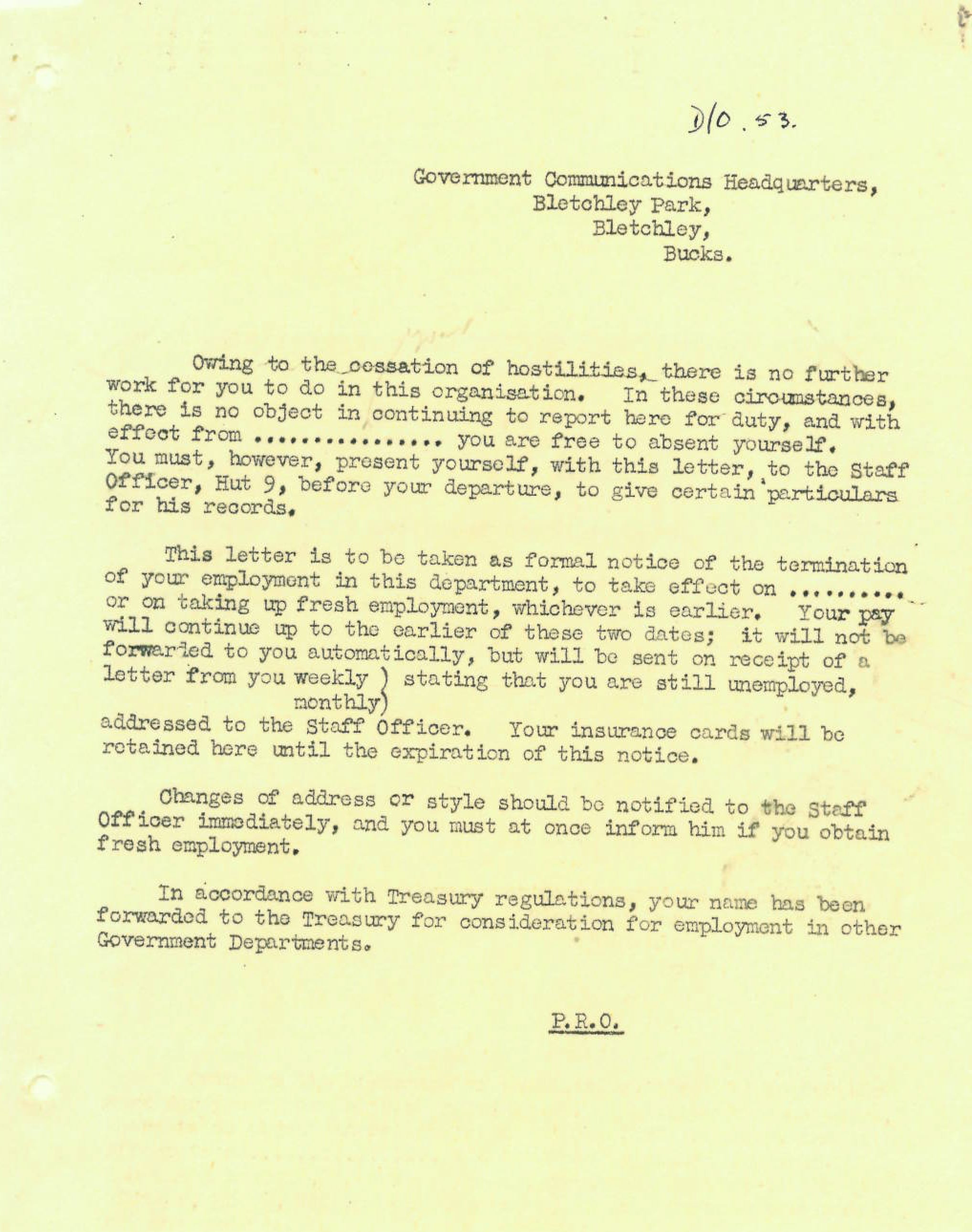
The second document is a termination of employment letter issued to GCHQ staff after VJ Day was declared. This would have been used as a template for managers to fill in the appropriate dates and issue to their teams. It states, “Owing to the cessation of the hostilities, there is no further work for you to do in this organisation. In these circumstances there is no object in continuing to report here for duty, and with effect from ****** you are free to absent yourself.”
Both of the letters address a gap in our knowledge of what happened after the surrender was declared and bring us greater understand of the mechanics of how the war was ended. While VE Day three months earlier marked the end of the war for many, most GCHQ staff went straight back to work on the effort to reaching VJ Day. These documents shed new light on how the infrastructure of war began to be slowly dismantled.
Marsha Quallo-Wright, GCHQ Director of Technology Futures, said:
“As someone working at the forefront of new and emerging technology for GCHQ, understanding our rich history is as important to me as looking to our future.
“We have a lot to thank our predecessors for, and the dedication and innovation shown by those working at Bletchley Park, GCHQ’s war time home, never ceases to amaze me. These documents help us to understand what happened to that workforce after six long years when VJ Day was declared. I’m pleased that we’re able to offer this insight into their world.”
However, the Second World War left lasting change. For GCHQ, there was no signals intelligence service before the First World War, but by the close of the Second World War, it was clear the country couldn’t do without one. The question then became what a British signals intelligence agency would look like. By 1946 GC&CS had become GCHQ and moved out of Bletchley Park to become more like the intelligence agency we know today.