The Bombing of Coventry in WWII
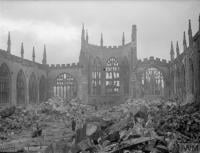
On 14-15 November 1940, a wave of German Luftwaffe bombers targeted the city of Coventry, an important engineering and armament production centre in the Midlands. There have been historical anecdotes (and a widely spread myth) that the city of Coventry was sacrificed to protect the Bletchley Park work on the German Enigma as a source. This is a complex story and is well dissected in Appendix 9 of Volume 1 of Professor Hinsley's History of British Intelligence in the Second World War. Almost a third of the city was flattened, with 568 people killed and hundreds more injured. Even the medieval cathedral was hit
On 11 November 1940 an Enigma decrypt of a message of 9 November showed that an unusual bombing operation was being planned; the codename MOONLIGHT SONATA suggested it would be at the next full moon (15 November) and that it might come in three parts – though four (unidentified) target numbers were listed.
The next day a Luftwaffe Prisoner of War (PoW) told a stool-pigeon sharing his cell that a heavy raid, at maximum strength, was to be carried out between 15 and 20 November (Goering believed that a major attack on a working class area would provoke an anti-war revolution), and that the targets were to be Coventry and Birmingham. Unfortunately a captured map suggested there were four future targets in London and the SE of England, which was just as good an interpretation of the Enigma evidence. Also on 12 November a further Enigma message gave beam transmitter (X-Gerät) bearings which intersected over Wolverhampton, Birmingham and Coventry; but again unfortunately, this was discounted, because there had been a lot of such messages, many of them setting up beam intersections over the industrial Midlands, and nothing had happened - they had just been practice.
On 13 November the prisoner was further interrogated and confirmed that there would be three separate attacks ‘in the industrial district of England’. All this evidence had been assessed and the results distributed to the usual authorities. The prisoners latest version caused an assessment made in the early morning 14 November to say that the operation might be in three phases on one night, or might be on three consecutive nights, with the former more likely.
A few hours later the Air Staff alerted the Prime Minister to the possibility of a major raid, saying that the targets were probably in or near London, but that ‘if further information indicates Coventry, Birmingham or elsewhere, we hope to get instructions out in time’. Churchill was informed that ‘the information which comes from a very good source indeed is confirmed to some extent by a Prisoner of War shot down on the 9th.’ Understanding that the original source was a decrypt, the expectation that the raids would be on London were sufficiently strong for the Prime Minister to arrange to be in London rather than in the country as originally scheduled.
At 1300hrs on the 14 November the beam transmissions began (as predicted in the first Enigma message which however did not give a date) and by 1500 airborne intercept had established that the beams intersected over Coventry, confirming both the date and the target for MOONLIGHT SONATA.
The beam jammers were switched on - they made no difference to KG100’s (Pathfinders) accurate arrival over the target, possibly because (as R V Jones’ section reported, but two months later) they used the wrong audio modulating frequency (if this was really the case, it is not possible to say how the mistake came about, whether it was because of poor measurement or a misunderstanding of the communications being used); but equally possibly, a bright moonlit cloudless night made navigation simple, and after the pathfinders had dropped incendiaries, the fires could be seen by aircraft from hundreds of miles away.
Interdiction attempts over German bases, were standard, but ineffectual; the AAA defences of Coventry had been strengthened early in November as part of normal planning, but were unable to cope with the numbers of aircraft; and although 121 fighter sorties were despatched, only 11 (out of 330) enemy aircraft were sighted, only two of these were engaged, and only one was damaged. There were not three separate attacks; possibly the three targets set up in the Enigma message of 12 November were alternatives, and Coventry was unlucky enough to be at the top of the list on a cloudless night.