D-Day, 75 years on
On 6 June 1944, Allied forces launched Operation OVERLORD, a combined naval, air, and land assault, on Nazi-occupied France
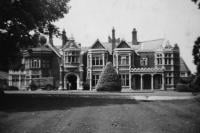
D-Day is the culmination of the work of signals intelligence (Sigint) in the Second World War and still serves as a challenge to today's GCHQ: when a British or allied force is deployed on operations, can we support it as well as our predecessors supported General Eisenhower, Commander of SHAEF, the Supreme Headquarters Allied Expeditionary Force, during OVERLORD?
Sigint's contribution lay in five main areas:
- Strategic Sigint: the work led by John Tiltman, William Tutte, and Tommy Flowers meant that by June 1944, Bletchley Park had access to the communications between Gerd von Rundstedt, the Commander of the German Army in the West, and Berlin. This gave SHAEF an insight into enemy capabilities, dispositions, and intentions.
- Tactical Sigint: from decrypted Enigma messages, Bletchley Park was able to give details of enemy order of battle in the areas where landings were due to take place.
- Deception: Bletchley Park's understanding of how German Sigint collected and processed information, and where the Abwehr, German military intelligence, thought its information gaps were, were a major contribution to the success of Operation FORTITUDE - the deception plan which aimed to convince the Nazi leadership that the Normandy landings were secondary to the Allies' main effort.
- Intelligence communications: Bletchley's ability to break and read Abwehr encrypted messages meant that Eisenhower could be confident that the Germans really believed that a fictitious formation, the First US Army Group, really existed in South East England and was poised to carry out landings in the Pas de Calais.
- German reporting on allied progress: as allied infantry and armour landed on the beaches and moved inland, the only means, initially, by which Eisenhower was able to keep up with the progress of the allied advance was by the timely processing of German messages. This message, saying that PEGASUS Bridge had been captured, was available to SHAEF just a few hours after a German commander in the field had sent it.
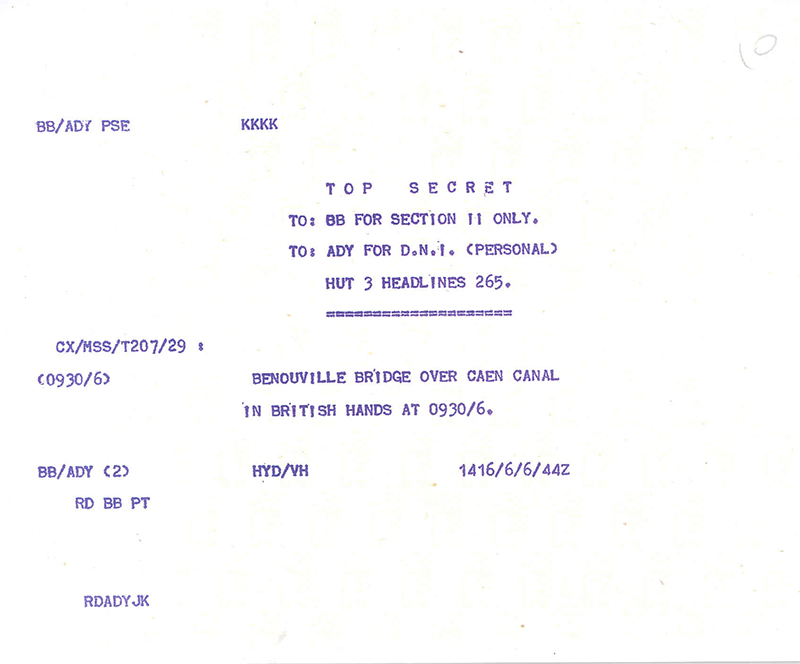
© Crown Copyright. Bletchley Park decrypt of intercepted German message reporting that PEGASUS bridge had been captured by the British.
Sigint was by no means the only source of intelligence to SHAEF: the work done by members of the Secret Intelligence Service and the Special Operations Executive, both by themselves, and by coordinating the work of the French Resistance gave unique information on the physical obstacles placed by the Germans to impede the landings and on the precise locations of units which Sigint could often only identify to a district. And, anyway, while intelligence could give a decisive information advantage to SHAEF, success was dependent on making that information useful to support the soldiers pouring into the landing areas and drop zones so that they could defeat the enemy.
Nevertheless, we can look back on what our predecessors did to support OVERLORD with great pride: during the period in the Second World War when precise intelligence was most needed, Bletchley Park supplied it.
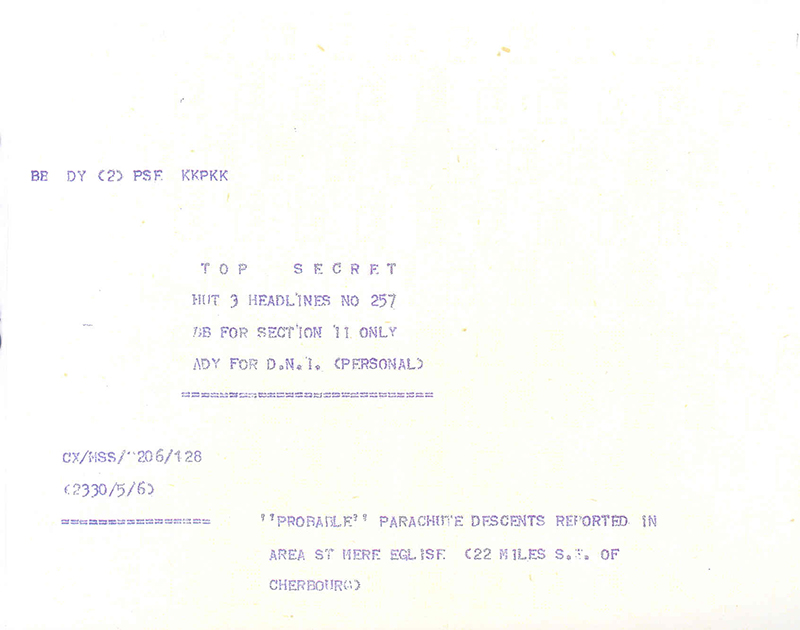
© Crown Copyright. Bletchley Park decrypt of intercepted German message reporting sightings of parachute descents at Ste-Mere-l'Eglise.