Branston Mere and the beginnings of RAF Signals Intelligence

From the 1920s to the 1950s, Branston Mere was one of several wireless telegraphy stations, known as ‘Y’ stations that operated across Britain intercepting enemy wireless and radio transmissions from the Continent. The significance of Signals Intelligence (Sigint) had been recognised in the First World War when the armed forces developed capacity and skills in intercepting the Morse transmissions of the enemy’s coded military messages. Most of this ‘listening’ activity ceased once the war ended, but through low profile operations, Britain’s armed forces continued to monitor radio activity from Europe.
During the interwar period, early intercepts at RAF Branston Mere enabled the British Air Ministry to ‘hear’ German bomber aircraft on training exercises that confirmed Allied suspicions that the German Air Force was re-forming. This was in breach of disarmament undertakings that Germany had signed as part of the Treaty of Versailles in 1920. Counting the number of call signs that the German Air Force was using, staff at Mere initially helped to determine the extent of the Luftwaffe threat. Their continued interceptions provided key data throughout the Second World War that helped the Allies identify German military strategy, as well as recording encrypted messages that were passed on to Bletchley Park for decoding. Branston Mere remained operational into the Cold War era, yet it is only recently that the secret activities and contributions of Mere and the Y stations have been recognised.
The secrecy surrounding the work of the ‘Y’ stations was essential to their success. The station at Branston Mere was ideally located to evade suspicions. The rural Lincolnshire countryside masked all intelligence activity. Yet, it was close enough to support nearby RAF Waddington and the flight training school at RAF Digby. The station raised little suspicion from local people. Under the later cover of trees, it was not easily detected from the air. All that was visible were a few wooden huts and four inconspicuous radio masts. This subtlety was perfect for the base’s secret operations, and coupled with military and civilian staff discretion, the set-up ensured Mere’s secrets were successfully guarded long after the Second World War ended until the ultimate closure of the base in the 1950s. Mere’s proximity to the nearest RAF base meant it was often referred to as Waddington. This assisted the station with its anonymity in the field, maintaining its cover as evidenced in military archival records.

An aerial farm at Branston Mere. © IBCC
There is uncertainty around the precise nature of work that took place at Branston Mere in the early part of the 1920s, but is it clear that in 1927, Branston Mere began to operate as the first RAF ‘Y’ station, and in September 1932 came under the command of then Warrant Officer, and subsequently Wing Commander William Swanborough. Swanborough was awarded an MBE in 1933, seemingly for the pioneering Sigint work he led at Branston Mere and across the RAF ‘Y’ services. He continued to lead the base through its most significant and productive period of Sigint activity, and while his headquarters moved to Cheadle in 1938, Swanborough maintained a regular presence at Branston Mere.
Those who worked at Branston Mere were initially civilians, although the majority were skilled, former RAF wireless operators. As the likelihood of war increased, the workforce expanded with staff increasingly drawn from the RAF. By the end of the Second World War, around 80 military staff worked on Sigint at Branston Mere ‘Y’ station, including a significant number of women from the Women’s Auxiliary Air Force (WAAF). East Mere Hall was requisitioned to accommodate the station staff which certainly beat the standard barracks offered to other personnel during the war.

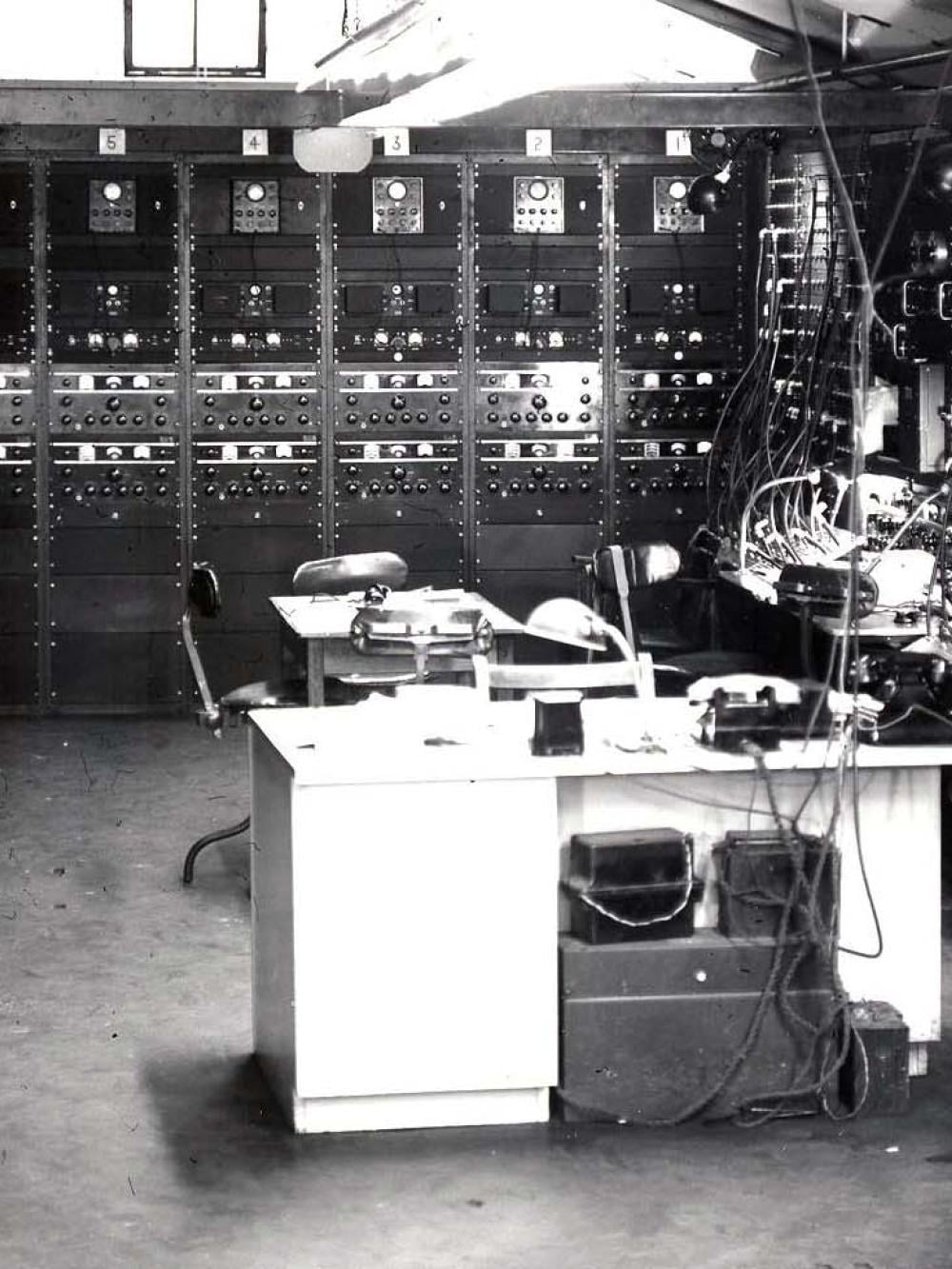
'Y' station Branston Mere. Permission given by Branston History Group.
As a Direction Finding (DF) intercept site, one of the principal goals of monitoring wartime activity at Mere was initially to establish where the radio activity originated from, and whether there had been any increase in volume of communication traffic. This information was then used to evaluate where the German forces were positioned. The monitoring of increased Luftwaffe activity also meant that the Allies had at least some advance warning of imminent German air attacks, even before the planes took off and could potentially provide earlier warnings than that offered by radar (see Stevenson). Operators also learned the various German plane call signs and were able to recognise the style of individual users, which meant they could anticipate which planes were preparing for action, either bombers or fighters, something early radar was not easily able to distinguish. Another success for British intelligence came from the interception of German meteorological flight communications. Due to the time sensitive nature of these weather messages the Germans chose not to feed them through Enigma. This allowed the allies to secure early information about German targets allowing them to respond accordingly.
However, Y stations like Branston Mere, had to also deal with sophisticated enemy encryption of signals traffic. Germany developed its complex Enigma cipher device to encode strategic messages and nullify the power of the intercept stations. Enigma was considered by most to be ‘unbreakable’. Branston-Mere and other ‘Y’ stations nevertheless continued to intercept the encrypted data, recording air-to-air and air-to-ground messages operating twenty-four hours a day, every day of the week. The encrypted messages provided high-grade wireless intelligence that was taken to Bletchley Park for decoding. At the start of the war, motorbike dispatch riders would make the arduous eighty mile journey to ‘Y’ service headquarters at Cheadle, Staffordshire. These secret communications were eventually delivered directly to the codebreakers at Bletchley Park via teleprinter. The collection, collation, and processing of the high volume of data from the ‘Y’ stations enabled allied success as every scrap of decrypted information was needed to build up a picture of what the Germans were doing, and what they planned to do in the field of operations. There is an interesting parallel to be drawn between the finding of patterns within the transmissions and later traffic analysis, a cornerstone of cyber security.
Of course, those working at Branston Mere had no idea how their work connected with that being carried out at Bletchley Park. Information was managed on a need-to-know basis, and even though operators recognised call signs, they were not able to associate, for example, the ‘D2600’ call sign with Hitler’s own aircraft. Their experience of their work was that it was technically difficult, required intense concentration and was rather dull. For example, at midnight every night, the Germans changed the frequency and call signs to obscure their transmissions so operators would have to search across the entire frequency band to find the new signal and continue their listening endeavours.
The men and women of Branston Mere completed their work in cramped and uncomfortable conditions with no distractions and nothing meaningful attached to the codes they were recording. Perhaps because of the intensity of their work, and the secrecy of what they were doing, the station staff formed a close-knit community which boosted morale and provided a sense of community. Ted Liddel’s in-house satirical magazine, Mere Gen, focused on the internal politics of the station and in-house jokes that featured many of the staff.
This cartoon is taken from the 1942 Christmas edition of Mere Gen. It depicts an airman dreaming of Father Christmas delivering a sack full of desired paperwork – the R.A.F. Form 295 whereby staff at Branston Mere were permitted leave.
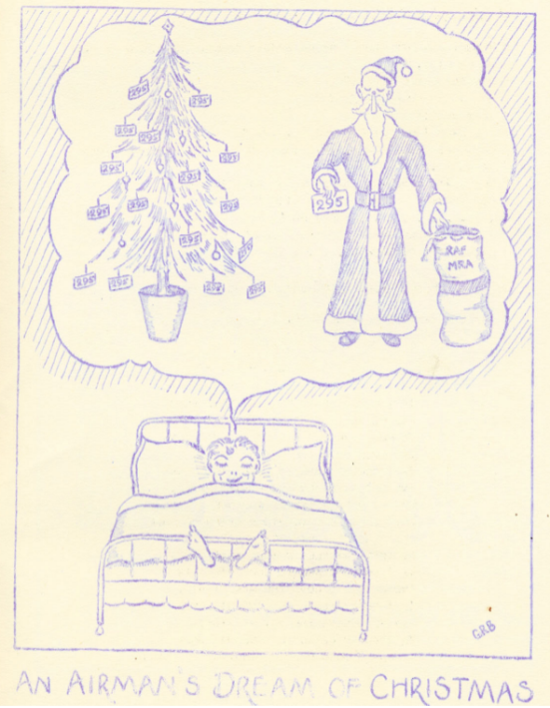
Mere Gen 1942. © IBCC
The professionalism and comradeship of station staff was evident to those who joined after the war (Cliff Oldfield – Branston History group), and in the annual staff reunions that continued for years after the station closed.
After the war the Branston Mere ‘Y’ station continued its duties until around 1948, with a reduced and increasingly civilian staff, before activity became substantially reduced. The base was brought back into more active sigint work for a short period in the 1950s when it was needed to monitor Soviet activity. By 1957, all work at Branston Mere had stopped. The land was finally sold in 1967. Sadly, derelict buildings were demolished in the early 2000s. All that remains are the imprints of aerial masts.
This article was written in collaboration with a Military History student at Bishop Grosseteste University, Lincoln.