William Swanborough
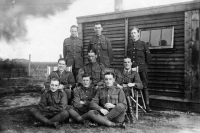
© Crown Copyright 2019
When most people think of the stars of Signals Intelligence history, they think of the men and women at Bletchley Park who worked during the Second World War to crack enemy codes and provide Britain with vital intelligence. They will think of Alan Turing or Dilly Knox.
William Green Swanborough is a lesser-known name, but one who set the scene for those who came after him and was in his own way one of the most important figures in British Signals Intelligence history.
Swanborough joined the Signals Service of the Royal Engineers as a Self-Trained Radio Operator. He served in the UK before receiving notice of being posted overseas on 13 November 1918. By December 1919 he was in India after re-enlisting for 3 years as a Wireless Telegraphist in the Indian Royal Engineers Signal Service. From India he was ordered to Kabul to support Sir Henry Dobbs' mission there to establish diplomatic relations with Afghanistan.
He left the Army and went to Port Sudan for a brief period as Superintendent of the Wireless Station, but then enlisted in the Royal Air Force (RAF). He was specifically charged with forming, training and managing the intercept station which Lord Trenchard had decided to establish at Mere Branston. The station was stood up formally in 1927 and marked the founding of RAF Signals Intelligence.
In 1931 Swanborough went to Estonia to negotiate an agreement with the Estonians to swap UK expertise for valuable Estonian intercept. He taught the Estonians the principles of Signals Intelligence against military targets: the need to identify networks and work out the hierarchy of individual units, the importance of understanding routine so that out of the ordinary activity would be immediately obvious and the need for continuity. He returned to the UK with an agreement that the Estonians would forward the encrypted Soviet military traffic they had access to. This material was sent to the UK right up to the outbreak of war.
After his return to the UK, Swanborough was commissioned. He moved the Signals Intelligence operation to RAF Cheadle in 1937 and commanded the station throughout the war, overseeing its massive expansion and the growth of a series of satellite stations. He was promoted Wing Commander in 1943.
After the War RAF Cheadle remained as the Air Ministry's main civilian collection site until 1964, when all the service ministries' civilian interception sites became part of GCHQ. Swanborough left the Air Ministry and became the first GCHQ civilian officer in charge of the station at Cheadle in January 1964. He retired shortly afterwards that same year with a record period of 37 years in charge of a station. He died in 1979, aged 80 and left behind a legacy that included laying some of the foundations for British Signals Intelligence.