Peter Frank George Twinn CBE
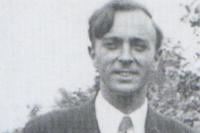
Recruited from Brasenose College, Oxford, in 1939 as the first GC&CS mathematician, Peter Twinn would go on to become one of the most significant cryptanalysts at Bletchley Park during the Second World War. Twinn helped deduce the internal Enigma wheel wiring configurations in 1939 and contributed to the design of the electromechanical Bombe machines.
Twinn was born on the 9th January 1916 in Streatham, South London and attended Manchester Grammar School, Dulwich College and then studied Mathematics at Brasenose College, where he graduated with a First in Mathematics in 1938. He joined GC&CS in early 1939, when the organisation was still based in London and when it relocated to Bletchley Park Twinn worked with Alan Turing and Dilly Knox on the Enigma cipher systems. He was the first British cryptanalyst to read a German Enigma message, using critical information that the Poles had provided in July 1939. By early March 1940 he had broken out a number of German Naval Enigma messages originated in late 1938, using the ‘Fort’ crib method.
In 1943/44 Twinn was working on the Bombe machines which specialised in processing German Intelligence Service (Abwehr) Enigma traffic and were described as ‘Twinn-Type Bombes’. The first of these, nickname Funf was installed at Bletchley in November 1942, a second (Eureka) in September 1943 and a third and final Twinn-Type Bombe (Oracle) was installed in May 1944.
Twinn was a member of the Military Section under Colonel John Tiltman in early 1940 when he was classed as a War Office civilian. Twinn was one of the founder members of Hut 8 from early 1941. He left Hut 8 in January 1942 to become Deputy to Knox in the ISK (Intelligence Services Knox) Section which worked on Abwehr Enigma. He was then appointed Head of the ISK Section in February 1943 following the death of Knox. As Head of the ISK Section he attended the regular Radio Security Intelligence Committee (RSIC) meetings on the German Abwehr at MI5 Headquarters. He was later appointed the Head of the Machine Research Section in September 1945.
After leaving Bletchley Park at the end of the war Twinn made a career in the Civil Service. By the late 1960s he was responsible for the development of the Hovercraft Programme in the Ministry of Technology. After this role he went on to succeed his former ISK colleague at Bletchley, Keith Batey, as Secretary of the Royal Aircraft Establishment (RAE). He was awarded a CBE in the 1980 Queen’s Birthday Honours list.
Twinn died on the 29th October 2004.