Oliver Strachey CBE
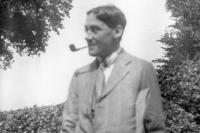
Born on the 3rd November 1874, and educated at Eton College, Strachey was one of the original cryptanalysts in the beginnings of GC&CS in 1919.
After studying music in Vienna for several years he eventually found a post as a traffic superintendent with the East India Railway Company but intensely disliked the work and life in India. He had aspirations to be a concert pianist. In 1915 he joined the small cryptanalysis section, known then as MI1(b), in the War Office under the leadership of Major Malcolm Hay and was sent to Egypt in 1916 to establish a small cryptanalytic unit there, coming close to losing his life after his ship was torpedoed and sunk.
In the interwar period he joined the GC&CS as a Senior Assistant working mainly on American codes during the 1920s. Working closely with Hugh Foss he helped break an Japanese Naval cipher system (known by the Americans as M-1) in September 1934. They were also responsible for the GC&CS solution a few months later of the 'Type A' cipher machine used by Japanese Naval Attaches and the Japanese Foreign Office.
During the Second World War he began work on the German Abwehr intelligence service traffic at Bletchley, leading the team which became known as ISOS (Intelligence Services Oliver Strachey) which would provide a vital insight into the deception activities of the German double agents being run by the XX Committee.
Canada and the Examination Unit
On the 9th June 1941 the Examination Unit (XU) was established on Montreal Road in Ottawa headed up by American cryptanalyst Major Herbert Yardley, who was the former head of the American Cipher Bureau, a joint War and State Department cryptanalysis agency. The XU was at that time administered by the National Research Council and staff were recruited from other Government Departments or the University of Toronto. Yardley was an anathema to GC&CS and it wasn’t long before Britain and America refused to work with the XU because of the publication of Yardley’s controversial book ‘The Black Chamber’.
Strachey was sent to Canada in 1941 with BP colleague Margaret Rogerson to head a small SIGINT unit (called the 'Examination Unit') in the Department of External Affairs. Strachey had taken with him copies of Vichy French ciphers, as well as Japanese and German keys. As well as working on Abwehr signals in Canada, Strachey was also working on some Vichy French traffic before returning to the UK six months later, in September 1942.
Strachey was succeeded by Tony Kendrick, a younger and energetic cryptanalyst from GC&CS who would further drive forward operations within the Examination Unit. In December 1942 Strachey successfully opposed an unwise British proposal to close the Examination Unit.
As interception and cryptanalysis started to bring success their intelligence was increasingly shared with other Allied nations. By the Spring of 1945 Kendrick was called back to Britain and Gilbert de B Robinson assumed Acting Directorship. In July Robinson returned to the University of Toronto and the XU was absorbed into the newly formed Joint Discrimination Unit (JDU) under the leadership of Colonel Edward Drake who would lay the foundation of what CSE has now become. The CSE Headquarters in Ottawa now takes his name and celebrates it's 75th anniversary on the 1st September 2021.
Strachey was appointed CBE in 1943, and he retired that year after suffering from a heart attack aged 69. He died on the 14th May 1960 in Ealing, London.