Dr Maxwell Herman Alexander Newman
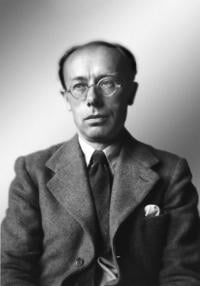
Born on 7th February 1897 in London, Newman was educated at the City of London School and St Johns College Cambridge, specialising in Mathematics. He was made a Fellow of St John’s in 1923. In 1927 he was appointed a University Lectureship in Mathematics at Cambridge. Between 1928-1929 he was a Rockefeller Research Fellow at Princeton University. Between 1926 and 1942 be published over twenty groundbreaking papers on topology and mathematical logic. He was the first British mathematician to work in combinatorial topology.
Newman started work at Bletchley Park on the 31st August 1942. He was instrumental in exploiting the cryptologic work of Tutte and Tiltman by the development of specially designed machines to speed up the process – and on the 1st February 1943 the Director of GC&CS (Edward Travis) established the ‘Newmanry’ for ‘carrying out research on specially designed machines to bring to notice clues upon which a cryptographer can work.’ Newman and his team diagnosed the cryptography of the German TUNNY (Lorenz SZ40/42 Geheimschreiber) on-line enciphered teleprinter and recognised a vulnerability in it which allowed the Allies access into the very highest strategic plans and thinking of the German High Command and Hitler himself.
In February 1943 the team, working with Tommy Flowers from the GPO Dollis Hill research branch, concluded no mechanical device could implement the arithmetic of the Newman/Turing attack would be fast enough to be useful. Flowers suggested a device based on thermionic valves could work. This led to the development of COLOSSUS, the world’s first electronic computer. Weighing about a ton, the first COLOSSUS took 10 months to build and was delivered to Bletchley Park on the 18th January 1944. It was followed by further COLOSSUS computers and they had a marked effect on the intelligence provision for D-Day and the opening of a second front in Europe.
After the war, Newman was given the Fielden Chair of Pure Mathematics at the University of Manchester in September 1945. He recruited Bernard Neumann, John WS Cassels and Alan Turing into the Department. There he began development of a new project, the ‘Baby’ with a long division routine provided by Turing with backing from the Royal Society (they awarded him a grant in May 1946 to build a computing machine). Two key individuals experienced in electronic circuit design, Frederic Williams and Tom Kilburn, were recruited from TRE (Telecommunications Research Establishment) to build it. Newman had taken two of his COLOSSUS team from BP with him to Manchester, Jack Good and David Rees.
Fred Williams was to state, ‘now let’s be clear before we go any further, that neither Tom Kilburn nor I knew the first thing about computers when we arrived at Manchester University…Newman explained the whole business of how a computer works to us.’ The ‘Baby’ ran for the first time on 21st June 1948 and is regarded as the world’s first general purpose stored-program computer. It heralded the dawn of computing.
Newman retired from the University in 1964 and died in 1984.