Hugh Foss
Bletchley Park cryptanalyst whose Japanese language skills came into good use against Japanese machine cipher systems
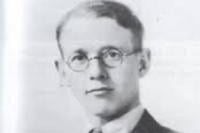
Hugh Rose Foss was born in the city of Osaka in Japan on the 13th May 1902, but was educated back in Britain at Marlborough College and then Christ’s College in Cambridge. He graduated in June 1924 with a BA and went on to join GC&CS in December 1924. He quickly showed an innate talent for cryptanalysis and his Japanese language skills came into good use against Japanese machine cipher systems.
In 1927 Foss wrote a paper to propose a way of breaking the Enigma cipher which was entitled ‘The Reciprocal Enigma’ (which can be found in TNA at Kew under HW25/14). He was also the first to succeed with Alan Turing's technique for reducing the possible wheel orders – a technique named ‘Banburismus’. During the Second World War, Foss worked initially in Hut 8 in 1940 on the Bombe menus worked out from cribs and developed a unique system called the ‘Foss Sheet’ which was a method to record the outside indicators of Enigma messages.
He went on to head the Japanese Naval Cryptography Section and was sent to Washington between January and July 1944 to assist the US Naval OP-20-G team. Along with Hugh Alexander, he made a major contribution to the US team tackling the Japanese Naval Attaché machine, known as CORAL, which was broken in March 1944. Amongst his other achievements he was an outstanding Scottish Dancer, composing, compiling and publishing a number of dances. He ran the Scottish Dancing Section of the BP Recreational Club.
He continued to work for GCHQ, retiring in 1953. He died on 23 December 1971.