Alastair Denniston
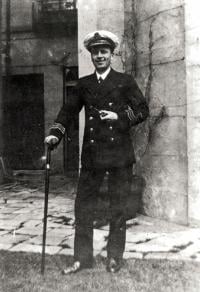
The First World War
On the outbreak of war in August 1914, Denniston was still teaching at Osborne. As reservists were called up and regular members of the Royal Navy went to war, naval coastal wireless stations began to intercept more and more communications from the Imperial German Navy. These messages were sent to the Admiralty in London, where a team under Sir Alfred Ewing, the Director of Naval Education, were tasked with deciphering these. As a German linguist with an inquisitive mind, Denniston was one of the first people Sir Alfred recruited to work in the now famous Room 40 of the Old Admiralty Building.
As a cryptanalyst, Denniston spent the majority of the war in Room 40 but he also undertook a number of other assignments. He was at Scapa Flow as an interpreter when the German Fleet surrendered and also led a small signals intelligence team at the Paris Peace Conference in 1919, where he worked closely with the French. In 1917 he married Dorothy Gilliat, his sister's best friend, and a co-worker in Room 40.
Denniston's personal qualities meant the Admiralty determined he should head the peacetime national signals intelligence and communications organisation, and he became the first Head of the Government Code & Cypher School (GC&CS) when it was established as part of the Admiralty on 1st November 1919.
Government Code & Cypher School
Under Denniston's leadership, GC&CS enjoyed great success during the 1920s - with the exception of countries using the 'One-Time Pad' system, all foreign diplomatic encryption systems which produced enough material for a cryptanalytic attack were broken and read in the 1920s. But GC&CS was operating under a set of constraints that were more damaging than anybody realised in the interwar years. No significant work was done against military targets until the mid-1930s; traffic analysis had been abandoned after the First World War; and the step change in cryptology produced by electromechanical encryption systems such as Enigma was not really appreciated.
In the late 1930s, Denniston was much involved in the development of Sigint relationships with the Polish and French, and in planning for the wartime expansion of GC&CS; work that proved invaluable in 1939 when GC&CS moved to its 'war station' at Bletchley Park.
Denniston remained Head of GC&CS at Bletchley until 1942, when a major reorganisation saw the diplomatic and commercial part of the organisation move back to London under him - as Deputy Director (Civil) - but the military part remain at Bletchley under his erstwhile deputy, Edward Travis, as Deputy Director (Services). Denniston retired from GC&CS in 1945.