Hugh Alexander
The great mathematician G. H. Hardy described C. H. O'D. Alexander as the only genuine mathematician he knew who did not become a professional mathematician. Hardy recognised that Alexander's failure to win a fellowship at the Cambridge Tripos exams was most likely due to his attention being absorbed by chess. Conversely, Alexander's fellow chess International Master Harry Golombek said of the two-time British Champion "the demands of his profession left him with comparatively little time for [chess] practice and study; otherwise he would certainly have been of true grandmaster class, and possibly even of world stature". Above both chess and mathematics, Alexander prioritised leading the British Government effort on cryptanalysis.
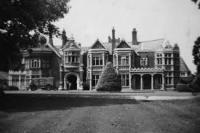
Alexander was an early recruit to Bletchley Park; he began in Hut 6 working on Army and Luftwaffe Enigma messages before moving in 1941 to Hut 8 to join Alan Turing's work on the Naval Enigma. Alexander had one of the most agile minds of the new breed of mathematical cryptanalysts; he proved the best at the pen and paper methods of 'banburismus' that reduced the computational work of Enigma attacks and his military aptitude test assessed him as suitable for development up to four star general. Although he has not achieved the renown of Good, Turing, Tutte, and Welchman, he was responsible for many breakthroughs. Perhaps the most significant was spearheading the UK-US joint work breaking the Japanese CORAL system used by Naval attaches. More importantly, as a former teacher and head of research at John Lewis, Alexander was much better suited to the organisational and administrative tasks of Hut 8 than the hyper-rational Turing. Alexander gradually assumed more and more of this work. The story goes that one day when Turing arrived late at the Park and the record book asked him to name the head of his section; Turing wrote "Mr Alexander" and with the logic of bureaucracy Alexander was treated as the head of Hut 8 from then onwards. Praise for Alexander's leadership is a theme common to all those who worked in Hut 8.
After the war, Alexander briefly returned to John Lewis before returning to the new GCHQ and continued to excel as both a cryptanalyst and leader. By 1949 he had been appointed head of the cryptanalysis division. It was a post that he held until his retirement, despite offers of promotion to more senior positions. He used the weight of his position to testify strongly as a character witness on behalf of Alan Turing during Turing's indecency trial. By 1971, already past the age of retirement by two years, Alexander decided to step down. Both GCHQ and their partners were keen to make continued use of his expertise and offered all manner of consultative work, which he declined. He died in 1974 and although his obituaries rightly spoke in glowing terms of his chess achievements, the impact of his more secret work still cannot be fully revealed.