
William Thomas 'Bill' Tutte OC FRS FRSC
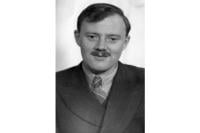
One of the foremost mathematicians of his generation, Bill was arguably the most significant cryptanalyst to work at Bletchley Park during WWII. He was recruited to GC&CS and worked at Bletchley between 1941 and 1945. By far his greatest achievement was to establish the internal structure of the German SZ40/42 Lorenz enciphered teleprinter (called TUNNY by the Bletchley teams), used by the German High Command. He devised a mathematical solution to establish the wheel pattern settings, which was to be one of the most significant intellectual breakthroughs of the war.
Born on the 14th May 1917 in Newmarket, he read Chemistry at Trinity College, Cambridge, graduating in 1938 with a First-Class Honours degree. He began post-graduate research at the University, and with a few friends he wrestled with mathematical problems like 'squaring the square.' His tutor at the College, Patrick Duff, recommended he join GC&CS. After a short training course he arrived at Bletchley in May 1941, immediately joining the research section. He was put to work on the Hagelin C38m cipher machine being used by the Italian Navy
After the war he continued with his research at Cambridge University, gaining his Doctorate in 1948. Tutte taught at the University of Toronto in Canada for thirteen years before gaining the position of Professor of Mathematics in 1982 at the University of Waterloo in Ontario.
Tutte was made a Fellow of the Royal Society of Canada in 1958, the British Royal Society in 1987 and an Officer of the Order of Canada in 2001. Canada's CSE dedicated their cryptologic research centre to his name in 2011, naming it the 'Tutte Institute for Mathematics and Computing' (TIMC). He died on the 2nd May 2002 aged 84 in Kitchener, Ontario. His home town of Newmarket dedicated a memorial for him in September 2014 at Rutland Hill.